_150x.png)
Evaluating Progress Since the Paris Agreement: The EU Green Deal's Impact on Climate Efforts Ahead of COP30
- Oct 10, 2025
- 2 min read
Updated: Dec 3, 2025
By Moraa Nyangorora
COP30, the EU Green Deal & a U.S. Exit — What They Mean for Global Climate Action


Kenyans observed Oct 10th to plant trees and clean the environment
The world soon meets in Belem, Brazil for COP30 in the face of three big climate narratives colliding: Europe’s bold Green Deal, America’s announced exit from the Paris Agreement under its new administration, and the urgency for global cooperation.


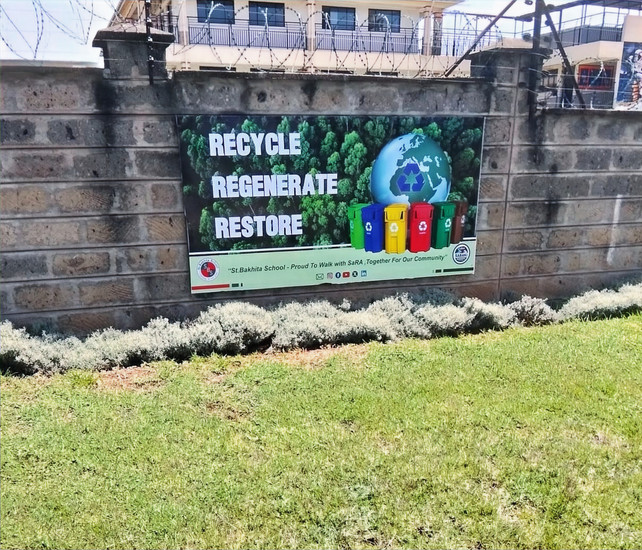


St Bakhita Primary School in Nairobi Kenya striving to create awareness on conservation through art
The European Green Deal, launched in 2019, is pushing Europe closer to becoming climate-neutral by 2050.
Through the deal, there have been major investments in renewables, adoption of stricter emissions laws, and support for a “just transition” to support communities affected by the shift.
Europe is sourcing nearly half its electricity from renewable sources — a signal that policy and investment can move the needle. Far from being perfect, the EU green deal is seen as providing a model for ambition, aligned with accountability.
Dampening this spirit, however, was the declaration and signing of Executive Order 14162 by the US President Donald Trump on January 20, 2025, withdrawing from the Paris Agreement and related climate commitments.
A move that derails and complicates climate finance commitments, especially when it comes to implementing global funding goals. Reuters
Although some states, cities and coalitions within the US are pledging to pursue Paris goals independently, the withdrawal affects the US influence in shaping global rules, policies and carbon markets. There is rising criticism of the move, with fears of a leadership vacuum that may be filled by the EU or China. Clean Air Task Force+2White & Case+2
The US withdrawal, thus, is perceived as raising the stakes for other players and making COP30's success more crucial.
COP30
The meeting of the Conference of the Parties is expected to review and update climate commitments (NDCs), negotiate finance for adaptation and loss & damage, and chart pathways for carbon markets.
However, many countries are behind on submitting their updated climate commitment, NDCs, and financing remains contentious. Le Monde.fr
Europe is anticipated to enter COP30 with its Green Deal credentials and ambitious climate laws as bargaining leverage.
Meanwhile, the U.S. absence will spotlight whether the global community can sustain momentum without one of its largest historical emitters.
For countries in Africa, Asia, and Latin America, COP30 offers both risk and opportunity:
Risk: With weaker participation from large emitters, pressure may fall on developing nations to carry more burden.
Opportunity: The EU (and possibly others) may deepen partnerships, technology transfer, and targeted climate finance to bridge gaps in trust and resources.
COP30 looms not just as another climate meeting, but as a turning point.
With the U.S. stepping back and Europe pressing forward, the world will watch whether climate diplomacy can hold together when even the “big players” falter.
Africa — including Kenya — must stay alert: engage boldly, demand accountability, and align climate diplomacy with local innovation and resilience.


Comments