_150x.png)
- Nov 1, 2025
- 4 min read
Updated: Dec 5, 2025
By Moraa Nyangorora
Rescue teams race against time as the Red Cross warns of rising flood risks and urges preparedness.
Latest deaths raise the death toll to 23 in a landslide in Chesongoch, Murkutwo and Kibendo in Elgeyo Marakwet County after heavy rains.
The Kenya Government, Red Cross and local teams are leading rescue efforts as the Kapsowar–Chesoi road remains cut off.
Experts warn of worsening climate-linked disasters amid renewed calls for community resilience.
Elgeyo Marakwet County is reeling from a series of landslides as extreme weather tightens its grip on Kenya's highlands.
Two more people have lost their lives in a landslide in the Kibendo area, and others were injured in the latest incident. This raises the death toll to 23, days after a massive one, witnessed in Chesongoch and Murkutwo, where the Kenyan government has confirmed 21 deaths, 30 missing, and 25 following heavy overnight rains.
Cabinet Secretary Kipchumba Murkomen led rescue teams by air in a multi-agency operation that has seen 19 rescued, according to police reports. He called for sustained mitigation and relocation efforts in high-risk zones.
Those on higher ground have been asked to leave as agencies coordinate relocation efforts. CS Murkomen has linked the frequent landslides to deforestation and farming in the Kerio Valley escarpments.
Video courtesy EMC News
Rescue operations are ongoing, with the Kenyan government, Kenya Red Cross, county emergency response teams, and community volunteers searching for survivors and supporting displaced families.
@KRC 2025
The road network damage has slowed rescue and relief efforts, according to residents, forcing relief agencies to seek alternative routes.
The Kapsowar–Chesoi road has also been cut off after flash floods washed away key sections, isolating several villages.
Video footage: Courtesy KNA (Kenya News Agency), November 2025
According to a Kenya Meteorological Department (KMD) advisory issued on October 23, 2025, the heavy rainfall is expected to continue in parts of the Rift Valley, Western, and Coastal regions.
“Residents in all the mentioned areas are advised to be on the lookout for potential floods and landslides. Flood waters may appear in places where it has not rained heavily, especially downstream,”
KMD Acting Director Kennedy Thiong’o.
The Kenya Red Cross Society (KRCS) confirmed that it has dispatched emergency teams to the affected area.
“Our disaster response teams are on the ground in Elgeyo Marakwet assisting with search and rescue, first aid, and evacuation,”
Kenya Red Cross Society on its official X account


Courtesy Kenya News Agency KNA
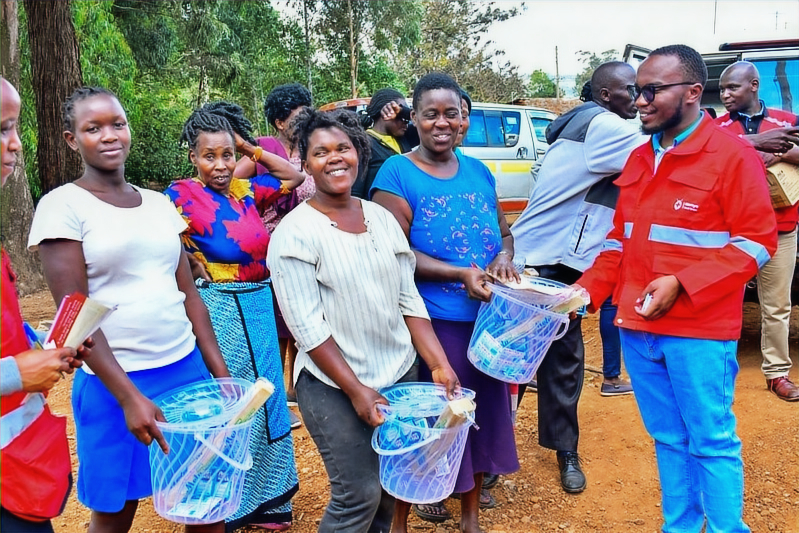
The Red Cross has also launched an appeal to support families affected by the continuing heavy rains across the country. These include food, temporary shelter, and medical aid for survivors.
Climate Change
Experts have consistently linked the rise in flash floods and landslides to deforestation, unplanned hillside settlements, and changing rainfall patterns driven by climate change.
The National Disaster Operations Centre has urged counties to integrate early warning data into their planning and public safety messages.
Community-led initiatives — such as tree-planting drives, soil conservation, and local early warning broadcasts through community radio — are proving effective in reducing vulnerability in flood-prone areas like Elgeyo Marakwet and West Pokot.
“We must strengthen community preparedness and ensure early warnings reach every household,”
KRCS Secretary General Dr. Asha Mohamed, in an earlier disaster preparedness briefing Source: Kenya Red Cross, Disaster Response Update 2025
Kenya braces for more rain, with the emphasis now shifting from post-disaster recovery to building resilience before the next storm — through climate-smart planning, sustainable land use, and stronger local information systems.
KENYA RED CROSS APPEAL
The Kenya Red Cross Society has launched an emergency appeal to assist families affected by floods and landslides across Elgeyo Marakwet and neighbouring counties.
The agency also urges residents to heed meteorological alerts, clear drainage channels, and collaborate with local early warning networks to prevent further loss of life.
SIDE BAR- ABOUT KAPSOWAR & TRENDS
Kapsowar is a hilly town in Elgeyo Marakwet County, about 60km from Iten. It sits on steep terrain where farming and livestock keeping are the mainstay. It boasts a beautiful landscape, but one that is fragile and prone to landslides during heavy rains.
In May this year, deep ground cracks and earth fissures were reported along escarpments (Keiyo South), an indication that the terrain is highly susceptible to landslides.
The County's 2023-2027 Climate Change Action Plan acknowledges that landslides are frequent in the area and lists the 2020 landslide that claimed 20 lives and major infrastructure losses as a reference point.
KAPSOWAR- TOWN IN ELGEYO MARAKWET |
Located on the western escarpment of the Elgeyo Highlands-60km northeast of Iten-120km from Eldoret |
The Kapsowar-Chesoi Road connects several remote villages in the Marakwet East Area. This road is often affected by heavy rains and landslides due to steep terrain |
Kapsowar hosts the Kapsowar Mission hospital-one of the oldest mission hospitals in the region,and several schools too. |
The area is hilly, green and scenic |
Agriculture is the mainstay of communities in Kapsowar |
Fact Box data Courtesy AI